



Dear Reader,
Over the years, I’ve noticed something about the families who build real, lasting wealth.
It’s rarely brilliance. It’s rarely constant activity either.
More often, it’s a quieter skill, knowing what to leave alone.
I was reminded of this by a study I return to every few years. It began in 1972, in Dunedin, a small city in New Zealand, where researchers started tracking more than a thousand children from birth. They measured health, behaviour, temperament, life outcomes, and they kept going for decades.
The finding was striking. One of the strongest predictors of how well those children did as adults, financially and otherwise, was self-control. Not intelligence. Not family background. Just the ability to resist the pull of the immediate and stay aligned with a longer-term goal.
In investing, that self-control rarely looks dramatic. Actually, It usually looks like restraint. Just the judgment to avoid disturbing what was built carefully in the first place.
This is harder than it sounds.
We live in a culture that rewards movement; refresh, respond, optimise, upgrade. When something matters to us, the instinct is to act on it. But investing has always contained an uncomfortable truth. It is that some of the best decisions you’ll ever make will feel completely inactive while you’re making them.
Warren Buffett made his first million at 30. The overwhelming majority of his wealth came much later because he gave good decisions enough time to work, rather than simply learning to think better.
That’s where many portfolios, even well designed ones, quietly run into trouble. It’s because they get disturbed too often, reviewed too casually and judged too quickly against the wrong yardstick.
A portfolio is a plan in motion.
It reflects your goals, your time horizon, your tax position, your family responsibilities, and, perhaps most importantly, your ability to stay calm when markets misbehave. Step outside that context, and even a polished review can mislead you. It might tell you what has recently outperformed. It will tell you very little about whether the portfolio is actually right for you.
I’ve come to believe that most wealth is lost through repeated, unnecessary interference or small doubts acted on too quickly. A single big mistake on the other hand can often be rectified with time.
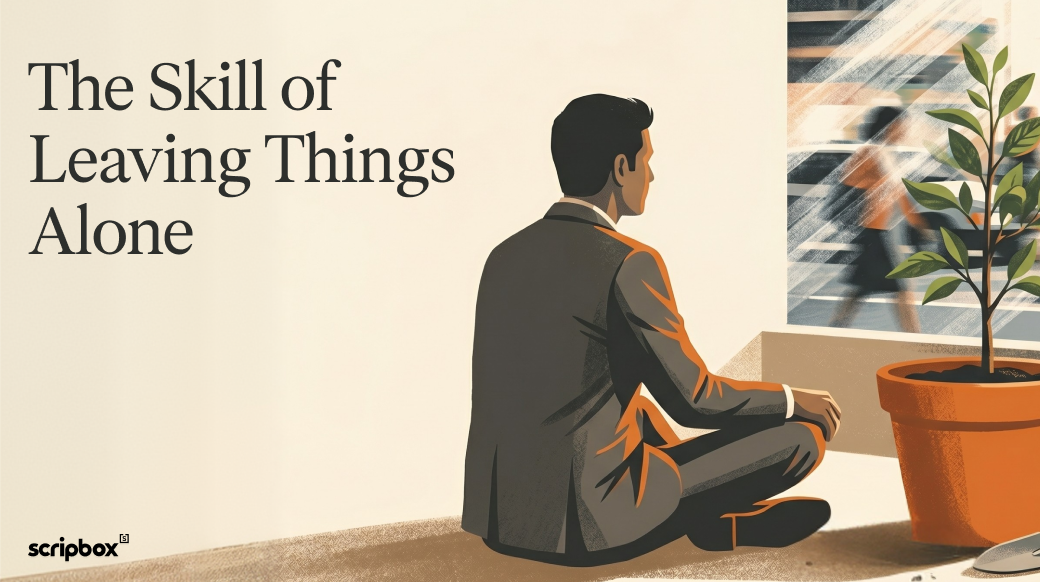
A good portfolio is a little like a healthy root system. Dig it up every few weeks to check whether it’s growing, and you may end up slowing the very growth you were hoping to measure.
Now, none of this is an argument for blind loyalty, or for never asking questions, and certainly not a case for miserliness.
Patience is anything but miserliness.
If you’ve worked hard, built wealth thoughtfully, and provided for what matters, some of that wealth should absolutely be enjoyed. Money is meant to improve life, not merely accumulate.
But that’s why clarity matters. A rupee meant for a family holiday should be spent with joy. A rupee meant for retirement should be left alone with conviction. The families who do this well are the ones who know what each pool of money is for, and are disciplined enough not to confuse one with another.
That, to me, is what patience in investing really is. Not saintliness or denial or endless waiting, but the quiet ability to leave the right things undisturbed.
Markets will rise and fall. Fresh reasons to review, react, and revise will keep arriving on schedule. The skill that will matter most may remain a very old one, knowing what deserves action, and what deserves time.
With regards,
Atul Shinghal
CEO and Founder, Scripbox
P.S. If you’ve been checking your portfolio a little too often lately, or feeling the urge to do something when the markets get noisy, that’s worth a conversation. Sometimes the most valuable thing a good advisor does is give you the confidence to leave a good plan alone.



 Google Play
  App Store
Show comments