



Dear Reader,
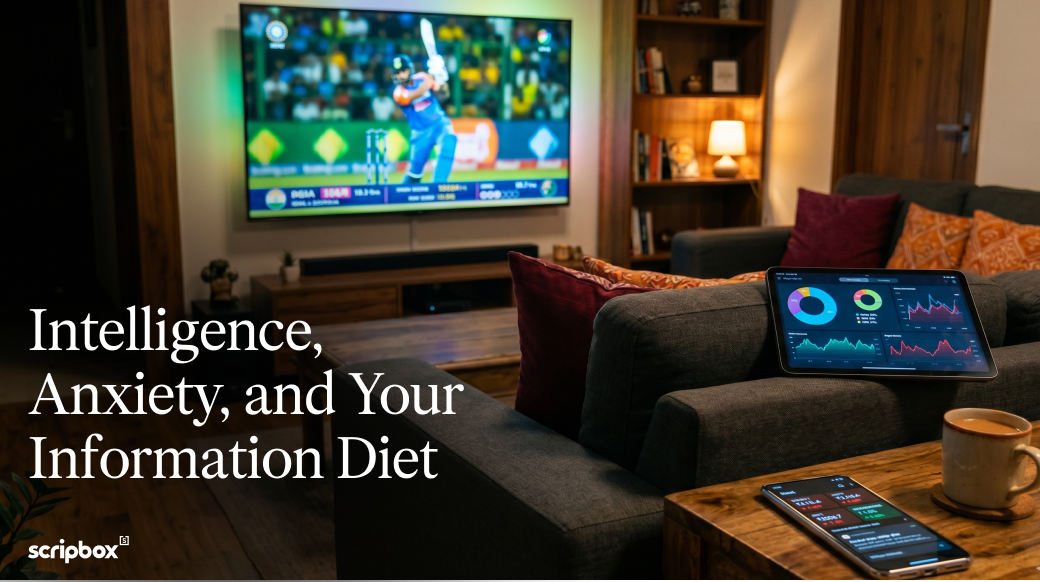
I was watching an IPL match recently when something in the ad break caught my attention.
Google and OpenAI were both there, competing for thirty-second slots alongside the cars and the soft drinks. Selling intelligence, on demand, to cricket fans.
That felt like a small cultural milestone. AI has entered the great Indian mainstream, somewhere between a cola ad and a cover drive.
And yet, in our conversations with clients, the emotion AI seems to be producing most reliably is anxiety.
About money, mostly. But also, about decisions, about whether one is missing something and about whether a carefully built plan is still the right plan.
The cycle has learned to sprint
In an earlier letter, I wrote about what I called the Affluent Anxiety Cycle. A market move triggers loss aversion. Questions multiply and confidence drops. Even people with carefully built plans begin to feel strangely untethered.
That cycle has not changed. But AI has made it faster.
When a market event happens today, a 2% move in the Nifty, a rate decision, a global headline, the commentary arrives instantly and from everywhere. Explanations, predictions, scenarios, summaries, each delivered with complete confidence.
The problem is that confident-sounding and correct are not the same thing. Your nervous system, unfortunately, does not always pause to examine the difference. It responds first to volume.
I see this in the people I speak to. Thoughtful, successful individuals who have built their wealth carefully over decades. People who understand that long-term investing requires patience. And yet, after an evening with the news and a few AI-generated summaries of what it all means, they find themselves questioning decisions that were made for good reasons. The noise does not discriminate and it unsettles the anxious and the confident alike.
The Google Doctor problem
I am also seeing a new version of this play out in real time. Clients are pasting portfolios into AI tools, asking for performance reviews, or checking their advisor’s recommendation against a chatbot’s opinion.
I understand the impulse. If intelligence is available on demand, why wouldn’t you ask for a second opinion?
The difficulty is that a portfolio without context is a bit like Google Doctor. The symptoms may be real, but the diagnosis can still be wildly off.
A portfolio is not a basket of products waiting to be graded. It sits inside a life. It reflects goals, time horizon, tax position, liquidity needs, family responsibilities, and perhaps most importantly, your ability to stay calm when markets are doing their best to be unhelpful.
Remove that context, and even a polished answer can be completely wrong for the person reading it. This is why the most important financial relationship you can have is with someone who knows not just your portfolio, but your life.
AI can explain, simplify, and educate. That is genuinely useful. But when your money is tied to your child’s education, your retirement, or your peace of mind, judgment still needs a human being. Because context matters, and because reassurance is not the same thing as information.
The scarcer asset
This is why I think an old idea has become newly important, your information diet.
Most of us do not really have an information diet. We have an information accident. News alerts, forwarded messages, dramatic headlines, all landing with equal urgency whether or not they deserve it. Much of what arrives daily is weather and weather has always had excellent marketing.
It helps enormously to decide in advance what will cause you to change your long-term plan, and what will not. A genuine shift in goals may qualify. A careful review with your advisor may qualify. A chatbot sounding alarmed at 11:47 pm almost certainly does not.
The families who hold steady through volatility are usually not calmer by nature. They are simply clearer in advance about what they will and will not react to.
In a world where intelligence is becoming abundant, judgment may be the scarcer asset.
It is worth protecting carefully.
Warm regards,
Atul Shinghal
CEO and Founder,
Scripbox
P.S. If recent noise has left you second-guessing a plan that was built thoughtfully, that is exactly the conversation we are here to have.
One call tends to be worth more than a hundred headlines.
Confused if your portfolio is performing right enough to meet your goals?











 Google Play
  App Store
Show comments